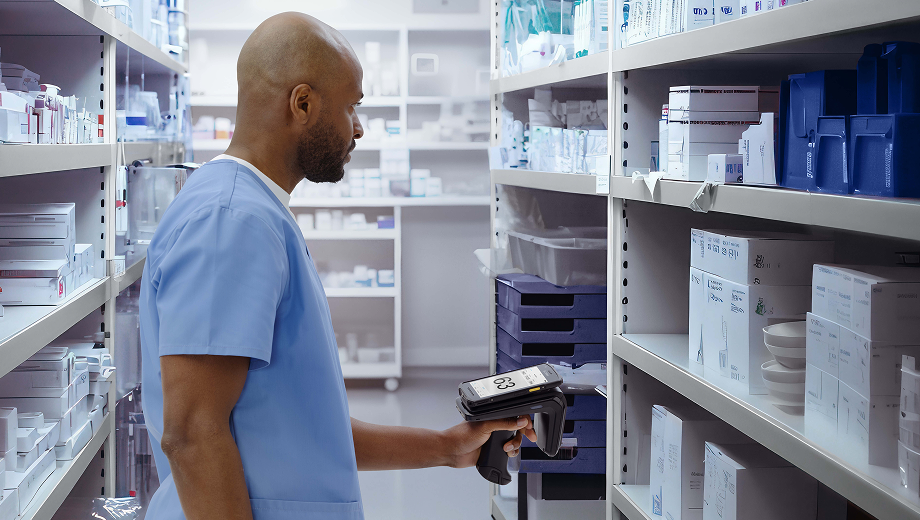



geo healthcare hero banner

The role of RFID (Radio-Frequency Identification) in healthcare

RFID & NFC in healthcare, turning vulnerability into intelligence with a trusted healthcare partner

RFID and NFC give every medicine, device, and consumable a unique digital identity. Instead of relying on manual checks or disconnected systems, healthcare gains item-level visibility that drives patient safety, regulatory compliance, trust, and efficiency across the full journey.

When every product becomes a trusted data point, long-standing vulnerabilities become solvable. RFID strengthens authentication, eliminates blind spots, and creates a supply chain where every dose is verifiable, traceable, and connected.

The healthcare challenges are significant and global. It is estimated that 10% of medical products in some countries are counterfeit or sub-standard, and up to 50% of prescriptions are either not collected by patients, or not taken as prescribed. As counterfeit pharmaceuticals continue to threaten patient safety, digital identity - enabled by UHF RFID, NFC, and dual-frequency inlays - creates a reliable, secure method to authenticate products and protect their journey from production to the point of care.


Table of content

geo healthcare hospital inventory 2

How RFID & NFC technology work in healthcare

Digital identity is enabled by three complementary technologies:

UHF RFID (long-range)

UHF RFID is the backbone of automated supply-chain and clinical operations.

Readers can capture hundreds of items per second without line of sight, making it ideal for:

  • Production-line tagging
  • Warehouse and distribution visibility
  • Hospital inventory and asset tracking
  • Automated replenishment and clinical efficiency

UHF RFID gives manufacturers and providers real-time, item-level insight across complex workflows.

NFC (short-range)

NFC brings digital identity directly to the patient experience. Any NFC-enabled smartphone can securely interact with a tagged medicine or device.

NFC is ideal for:

  • Patient authentication and avoiding counterfeit pharma
  • Guided therapy experiences and digital support programs
  • Device-to-cartridge safety checks
  • At-home adherence and treatment confidence

It creates a trusted, direct connection between patients, caregivers, and brands.

Dual-Frequency RFID (UHF RFID + NFC in one tag)
Dual-frequency tags combine the strengths of both technologies into a single digital identity.

  • UHF RFID supports automated visibility across manufacturing, logistics, and hospital operations.
  • NFC supports authentication, engagement, and safe use at the moment of care.

A single identifier follows the same product end-to-end, creating one truth for manufacturers, clinicians, regulators, and patients.

What makes digital identity work

Digital identity relies on three components working seamlessly together.

Tags or Inlays

Ultra-thin UHF RFID or NFC inlays are integrated into packaging, devices, or consumables. Each carries a unique, secure, encrypted identifier, and can include batch, serial, or expiry data. Avery Dennison inlays are engineered for healthcare environments, cleanroom workflows, and validated sterilization processes, combining robustness, chip protection, and consistent performance.

Readers
Different interaction points capture data depending on the workflow:

  • RFID tunnels, gates, and portals
  • Handheld UHF scanners
  • Smart cabinets and smart shelves
  • HF/NFC readers inside devices
  • NFC smartphones for patient-facing interactions
  • Readers translate physical events into accurate data.

The data layer

Each scan creates a secure, time-stamped event that becomes part of the product’s digital history.

This powers:

  • Chain-of-custody verification
  • Recall precision
  • Automated replenishment
  • Inventory visibility
  • Compliance and audit trails
  • Digital patient experiences

Importantly, tags contain no personal patient data. Sensitive information stays within secure systems and compliant workflows.

Why digital identity matters for healthcare systems

Digital identity is helping create safer, smarter healthcare by improving patient safety, trust between stakeholders, waste reduction, and operational efficiency across the healthcare supply chain.

Safety. From verification to prevention

Whether scanned through a logistics portal or tapped by a patient’s smartphone, each product becomes instantly verifiable. UHF RFID and NFC strengthen recall precision, reduce dispensing errors, and protect against counterfeit pharma at every stage.

Trust. A single, digital source of truth

Every medicine, device, and consumable carries a continuous record accessible to authorized stakeholders. Dual-frequency tagging ensures the same product identity supports manufacturers, clinicians, regulators, and patients.

Waste reduction. Accurate visibility across operations

Digital identity exposes hidden inefficiencies such as expired stock, misplaced devices, and unused samples, so waste can be actively prevented.

Efficiency. Freeing human capacity

Automation replaces manual checks, data entry, and inventory counts. Care teams spend less time searching, verifying, or documenting stock – and more time focused on patient care and clinical decisions.

Use cases

Digital product identity & traceability

Point-of-care inventory management

Brand & patient safety

Laboratory workflow automation

How do I get started?

First, share your situation so we understand the specific outcomes you expect.

Whether you’re a pharmaceutical manufacturer, a system integrator, or a healthcare provider, the first step is not technology, it’s a conversation exchanging expertise.

1. Start with your reality
We explore where visibility, authentication, or efficiency matter most, and the role of the solution within your unique context.

2. Business case
Together we build the business case. We can access deep technical, application, and business expertise within our team and via our global network of partners. 

3. Define your next step
That could be a pilot, a workshop, or a simple technical review. Together we agree on what helps you move forward with clarity and confidence. We tailor the approach to your goals, pace, and stakeholders.

FAQ:

How long does implementation take?

Typical pilots last 3–6 months depending on complexity and regulatory requirements. Full-scale rollouts can follow once interoperability and validation are confirmed.

What infrastructure is required?

UHF RFID solutions require RFID readers for reading tags at key points in the supply chain. NFC requires no additional hardware, patients can use their smartphones. Avery Dennison works with a network of system integrators to deliver end-to-end deployments.

What about cost and ROI?

The return on investment typically comes from reduced product loss, better adherence, fewer recalls, and greater operational efficiency. In most cases, these savings outweigh the marginal cost of tagging.


Together we’re turning vulnerability into intelligence — and making every journey safer.


RFID & NFC for pharma authentication & counterfeit pharma prevention

Counterfeit pharma is one of the most urgent threats to global health. RFID and NFC-based digital identity provides a robust, multi-layered defense:

  • UHF RFID provides item-level traceability through manufacturing and logistics.
  • NFC enables instant, secure authentication by patients or caregivers using a smartphone.
  • Dual-frequency tags ensure the same identity protects the supply chain and the point of use.
  • Tamper-evident NFC structures expose interference and protect brand integrity.

Patients gain the confidence of a simple, secure tap. Manufacturers gain verifiable proof of authenticity and a direct, trusted channel for digital support programs.

NFC for patient engagement, therapy support & at-home care

geo healthcare patient home medication

NFC enables instant communication between pharmaceutical brands and patients. A simple smartphone tap allows patients to:

  • Verify authenticity and avoid counterfeit pharma
  • Access clear guidance, dosing instructions, or support materials
  • Receive adherence reminders or connect to digital health services
  • Confirm that devices, cartridges, or consumables are correctly paired

For at-home therapies such as diabetes, oncology, fertility, or obesity treatments, NFC turns packaging into a trusted touchpoint that improves confidence and outcomes.

Automated stock control & high-value consumable management

UHF RFID transforms hospital and pharmacy stock control into a continuous source of operational and clinical intelligence:

  • Instant cycle counts in seconds
  • Expiry-aware visibility to ensure safe use
  • Accurate consumption data for forecasting
  • Reduced waste from expired or missing items

Dual-frequency tagging extends visibility from manufacturing to the operating room, ensuring the right product is available when needed.

Laboratory sample management & traceability

Accuracy is non-negotiable in diagnostic and research labs.

RFID and HF/NFC bring precision and accountability to every step.

  • Unique digital identity protects against mislabelling
  • Automated chain-of-custody reduces transcription errors
  • Real-time tracking prevents sample loss
  • Audit-ready data strengthens compliance

From intake to analysis, digital identity safeguards integrity and accelerates results.

Future trends: Sensors, interoperability & connected care

The next generation of healthcare identity is already emerging.

  • Sensor-enabled NFC can detect temperature, moisture, fill level, or leakage.
  • Dual-frequency DPP-ready labels support future digital product passport standards.
  • Unified data models strengthen interoperability with EMRs, ERP systems, and clinical platforms.
  • AI-driven insight uses trusted item-level data to predict demand, reduce waste, and optimize care delivery.

Digital identity enabled by UHF RFID, NFC, and dual-frequency technologies is transforming healthcare. It strengthens safety, builds trust, reduces waste, and frees human capacity across the entire ecosystem.

By giving every product a secure, verifiable digital identity, Avery Dennison and its partners are turning vulnerability into intelligence and acting as a trusted healthcare RFID & NFC partner, helping to make every journey safer, from production to patient.


Products and applications: How digital identification comes to life
Application area Challenge it solves               
Product exmaples                 
Ouctomes
Patient engagement & product authentication Counterfeit risk, lack of patient connection, poor adherence                                                                    NFC / HF Inlays – Circus™, Circus™ Tamper Loop, Miniblock, Microblock   Enable patients to verify authenticity and access therapy information directly via smartphone.
At-source tagging of drug delivery consumables Supply-chain blind spots, medication mix-ups, lack of unit-level traceability UHF RFID Inlays: Miniweb, Minidose, Minitrack                Tag vials, syringes, auto-injectors, and packaging at manufacture. Enable end-to-end visibility, faster recalls, and improved regulatory compliance.  
High-value consumables in healthcare settings Lost inventory, expired
stock, inefficiency in hospital operations

UHF RFID tagging integrated into hospital supply chains               
Track and manage medical devices and specialty pharmaceuticals automatically. Reduce waste and free up clinical time.
Laboratory samples & equipment tracking Sample loss, errors, and manual documentation HF & UHF RFID Solutions (custom inlays for
labware)
Ensure precise tracking of samples, reagents, and instruments across research and diagnostics workflows. Improve reliability and auditability.
Automated consumable protection Misuse
or cross-compatibility errors in multi-use devices (e.g. injection pens)
NFC-enabled cartridges with built-in reader verification Allow devices to confirm authenticity, expiry, and dosage before use. Protect patient safety and ensure correct product pairing.
Condition sensing applications Undetected spoilage,  leakage or temperature/moisture exposure    NFC passive sensor structures Detect fill-level, moisture, or pressure changes. Enable smarter packaging that prevents waste and supports quality assurance.
Direct-to-consumer healthcare models Growing online purchase
risk, brand-to-patient disconnect
NFC integration for authentication and engagement Build consumer trust in direct-ship models (e.g. diabetes, obesity, hormone therapy). Provide secure verification and access to digital health services.
Partner ecosystem integration Complex solution deployment, software–hardware integration gaps Avery Dennison+System Integrators (e.g. Turck Vilant, Bluesight) Combine proven RFID hardware with partner software platforms to deliver turnkey, validated healthcare traceability and visibility systems.